In pressure vessel engineering, the geometry of a dished head is defined primarily by two critical dimensions: the crown radius and the knuckle radius. These radii determine the structural behavior of the head under internal pressure, influence required material thickness, and ensure compliance with design standards such as those issued by ASME.
Understanding how these two radii work together is essential for safe, efficient vessel design.
What Is the Crown Radius?
The crown radius (CR or L) is the large, central spherical radius forming the main dish of the head. It defines the primary curvature of the pressure-retaining surface.
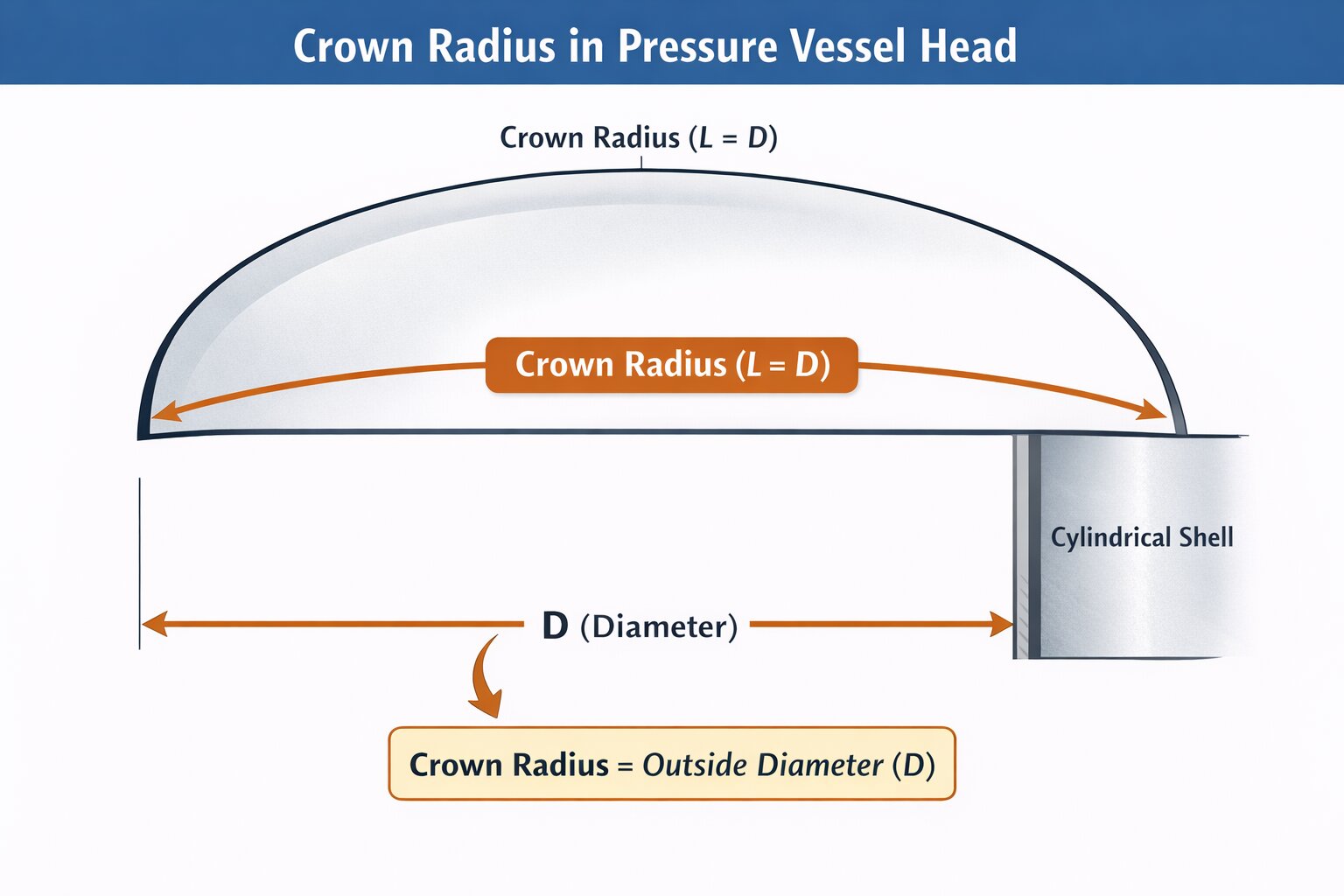
In standard ASME flanged and dished (F&D) heads:
Crown Radius = Outside Diameter (D)
This means the spherical portion of the head has a radius equal to the vessel’s outside diameter. Because the crown carries the majority of membrane stress under pressure, its curvature plays a major role in determining thickness requirements.
A larger crown radius results in a flatter head, while a smaller radius creates a deeper dish.
What Is the Knuckle Radius?
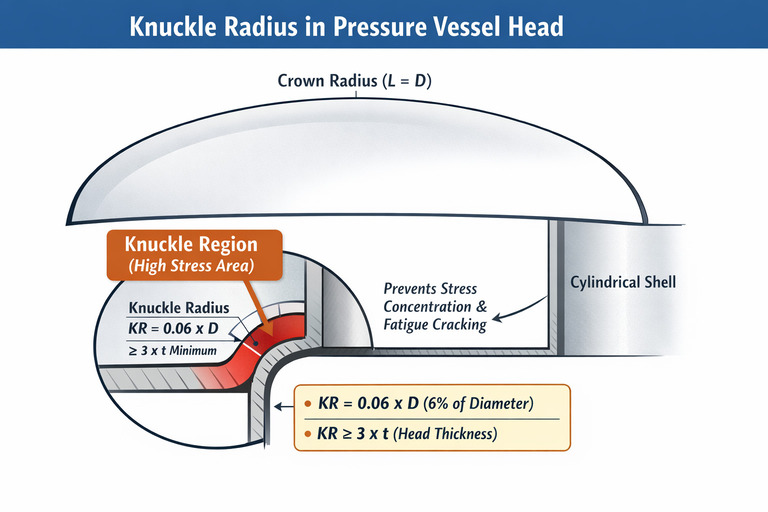
The knuckle radius (KR or r) is the smaller toroidal radius that transitions between the spherical crown and the straight cylindrical shell.
Its purpose is critical:
It reduces stress concentration at the junction between the head and the shell.
For standard ASME F&D heads:
Knuckle Radius = 0.06 × D (6% of the diameter)
Code requirement: Knuckle radius ? 3 × head thickness (t)
This minimum radius prevents excessive localized stresses that could otherwise lead to fatigue cracking or failure.
The knuckle region is typically the highest-stress area in a torispherical head.
How Crown and Knuckle Radii Work Together
In a torispherical (flanged and dished) head, the geometry is defined by:
Crown Radius (L) = D
Knuckle Radius (r) = 0.06 D
This combination produces a shallow, economical head that is widely used in pressure vessels for storage tanks, reactors, and separators.
Different head types adjust these radii to improve stress performance.
For example:
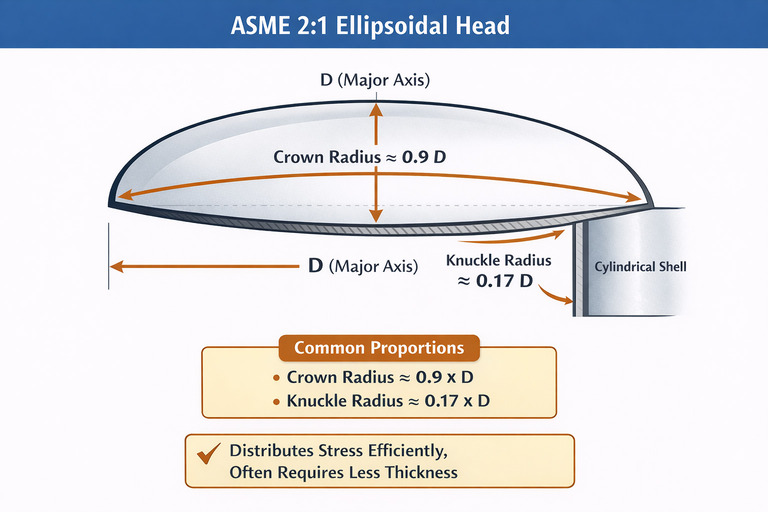
ASME 2:1 Ellipsoidal Head
True elliptical profile (major axis = D, minor axis = D/2)
Often approximated with:
Crown Radius ? 0.9 D
Knuckle Radius ? 0.17 D
Ellipsoidal heads distribute stress more efficiently than torispherical heads and often require less thickness for the same design pressure.